Port definition
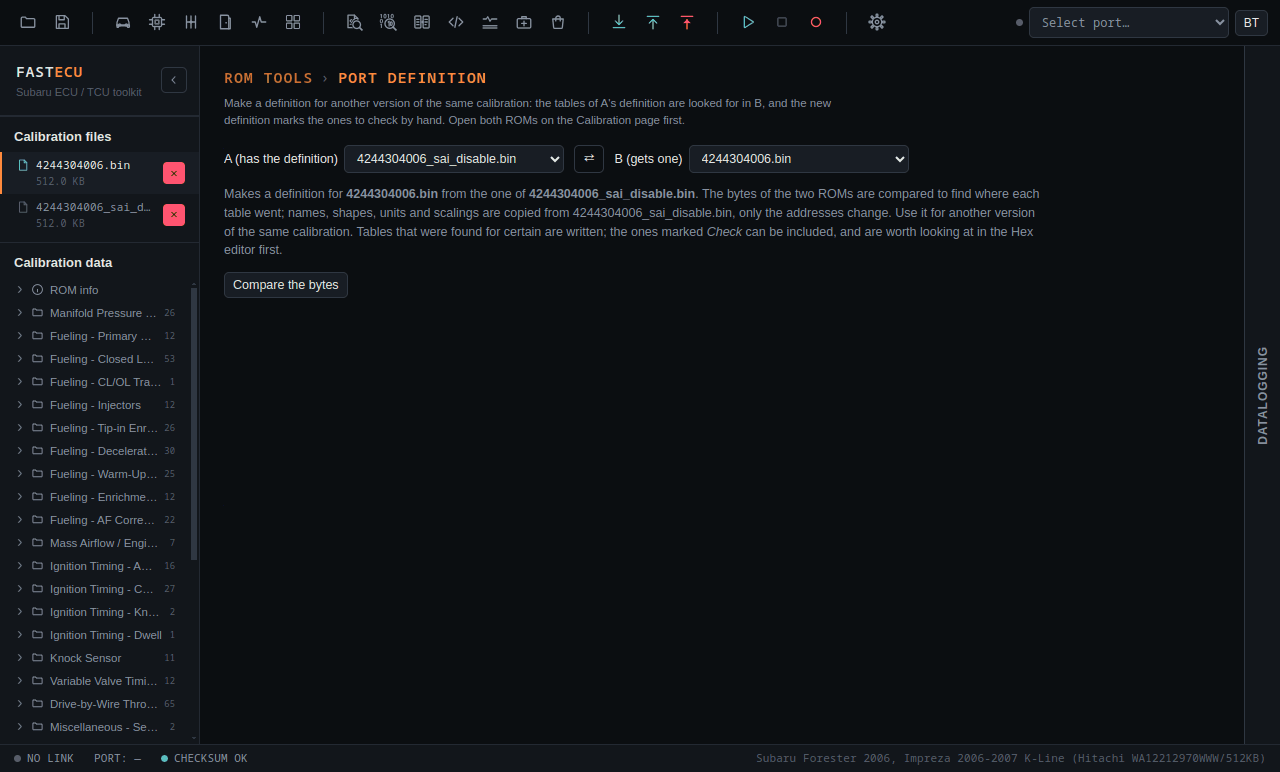
Make a definition for ROM B from the definition of ROM A, when B has none or is another version of the same calibration. Only the addresses move; everything else is copied from A.
Using it
- Open both ROMs first: A, which has a definition, and B, which needs one.
- Open Tools › Port Definition (or its toolbar button, if you have turned it on in Settings). Choose A (has the definition) and B (gets one); the swap button exchanges them.
- Press Compare the bytes, look at the result, then Create the definition.
What it finds
- Where each table of A went in B is found by comparing the two ROMs' bytes. Each table is marked Found (every part in exactly one place), Check (found, but the same bytes occur elsewhere or the table was changed), Not found or Not ported (selector and bit tables).
- In a test of Forester EA1M702A against EA1M500B (whose own definition gave the truth), 94 % of Found tables were right and 64 % of Check tables. Look at the Check ones in the Hex editor first.
- Create the definition writes the Found tables (and the Check ones if you tick it) to your Custom definitions as
<id>.xml. It never replaces a file, is self-contained, and makes B use it.
A ported definition is a good start, not a guarantee
Names, shapes, units and scalings are copied from A; only the addresses move. Check important tables against the ROM before you rely on them.